


This page is part of the project LABedia: Еncyclopedia of Late Antique Balkans, 4th-5th c.,
financed by the National Science Fund, contract КП-06-Н30/6, 13.12.2018
CULTURAL CENTERS IN LATE ANTIQUITY: PERGAMUM
| Sofia University "St. Kliment Ohridski" | DOI |
| Department of Classical Philology |
received 10.09.2022; published 13.10.2022 |
| This email address is being protected from spambots. You need JavaScript enabled to view it. | core article |
Abstract: This is a brief introduction to the city of Pergamum, its development as a cultural and educational center along with the public figures and activities that have been prominent there during the Late Antiquity.
Keywords: Pergamum, library, philosophy, Asclepius, theurgy, Priscus, Maximus, Chrysanthius
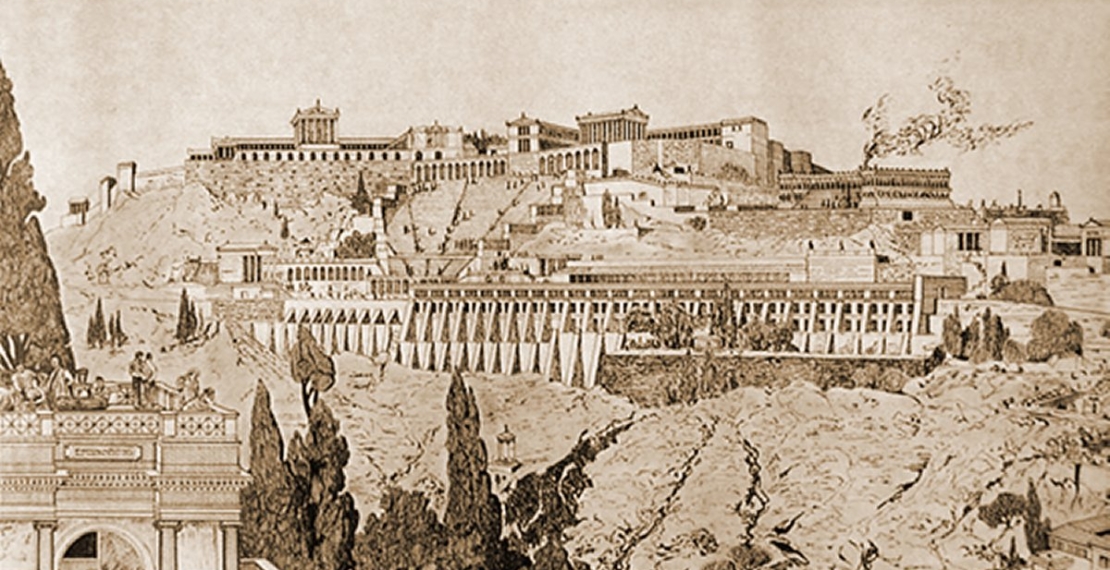
Pergamum was an ancient center of pagan philosophy and learning. In the Hellenistic period, the city was the center of the Attalid kingdom. The Attalid dynasty was a rival to the Ptolemies and was famous because of its prominent figures, who served as patrons of the letters and the sciences. Around 189 BC it was built as one of the most important libraries of the Hellenistic world on the Acropolis of Pergamum, which has flourished as the second largest library –following that of Alexandria– at least by the time of the Late Roman Republic. According to Plutarch at that time Mark Anthony gave 200.000 scrolls to the Egyptian queen Cleopatra – as compensation probably due to the burning of the Great Library of Alexandria by Julius Caesar[1]. According to a widespread legend reported by Pliny the Elder, it was in Pergamum that the writing material bearing the city’s name was invented and destined to dominate along with the form of the manuscript codex in the Middle Ages – parchment (in Latin pergamenum)[2]. Following the beginning of our era, sources also mention libraries in Pergamum, although not as important and prestigious. In the 2nd century, a similar library was founded, with a statue of Emperor Hadrian near it, by a prominent resident of the city, Flavia Melitina, who was the wife and mother of city councilors[3]. As archaeological and epigraphic evidence suggests this later library was located within the sanctuary of Asclepius the Savior (Ἀσκληπιὸς Σωτήρ), one of the most important cult centers of health deities in the ancient world. Here the famous orator Aelius Aristides of the Second Sophistic (2nd century), received a divine revelation from Aeschylus in the role not only of a healer but also of a personal savior and heavenly protector[4]. Therefore, it was not surprising that the city was chosen as the seat of the pagan philosopher Aedesius of Cappadocia. The latter was born near the end of the 3rd century into a not significantly wealthy family, then he was sent by his father to Greece (probably Athens) to obtain a promising education in order to become rich, however, he returned as a student of philosophy and later a follower of the Neoplatonist Iamblichus[5]. Eunapius, perhaps slightly exaggerating, describes how after the establishment of Aedesius in Pergamum, Greeks and all sorts of neighboring peoples began to flock to him[6]. Aedesius established a school and a family there while some of his most prominent students have been Maximus of Ephesus, Chrysanthius, and Priscus. Eunapius, who personally knew the disciples of Aedesius and listened to the lectures of several of them, reports that according to their descriptions, their teacher was an extremely amiable man, whom everyone could see in the city streets and was also able to converse on everyday topics with common persons as a vegetable seller, a weaver or a blacksmith– something that was not usual for other exalted adepts of Iamblichus’ Neoplatonism, such as the gloomy and taciturn Priscus[7]. The latter along with his schoolmate from the school of Aedesius, Maximus of Ephesus, became part of Julian’s entourage during his brief reign. However, despite his harsh character –or perhaps because of it– Priscus remained restrained philosophically even as part of the imperial court, and accordingly he did not suffer any punishment or retaliation from Julian’s successors after the death of the latter[8].
Unlike Priscus, the other popular philosopher from Pergamum, Maximus, was a much more prominent and controversial figure, who used to behave haughtily and lavishly in the court of Julian[9]. He managed to impress the future ruler in his youth when he toured the enlightened centers of Asia Minor and arrived in Pergamum. According to the biographer Eunapius, Julian listened in Pergamum first to Eusebius another disciple of Aedesius’, who presented himself as a proponent of that current in Neoplatonism, which relied more on traditional logical-rhetorical approaches to knowledge. Maximus, however, belonged to another type of Neoplatonists, who followed in the footsteps of Iamblichus into the so-called “theurgy” –communication with the divine world through the practice of special rituals. Eusebius told the young Julian of such a ritual, which he attended as a witness: it was in the sanctuary of Hecate, where Maximus not only made the goddess smile at his incantations but managed to light up the torches that she held in her hands. The future Caesar needed no more to follow the miracle worker and become his disciple[10]. Imposing in his appearance in his speech and his presence[11], popular throughout Asia Minor like his teacher Aedesius[12], Maximus is also described by Eunapius as being particularly self-assured in his theurgic rituals, almost to the point of sacrilege. When Julian invited his old teachers Chrysanthius and Maximus from Pergamum to his palace in Constantinople, they received unfavorable omens from the gods and Chrysanthius listened to them, but according to Maximus, the will of the gods should be tested until one received favorable omens for what would decide to do[13]. This is perhaps the most unapologetic attitude towards the divine, attested in the sources by an adherent of traditional religion in Late Antiquity.
REFERENCES
[1] Plut. Ant. 58. Evans, R. (2012), A History of Pergamum: Beyond Hellenistic Kingship, New York, 79-80.
[2] Plin. NH XIII.21.
[3] IvP 6, IvP 38. See Pearcy, L.T. (1985), “Galen’s Pergamum”, Archaeology 38 (6), 36.
[4] Ael. Arist. Orat. Sacr. 292-293, see also the translation of Behr, C. A. (1967), Aelius Aristides and the Sacred Tales, 224-225, where the visit to Pergamum is dated in the summer of 145 AD.
[5] Eunap. Vitae Soph. VI.1, PLRE I Aedesius 2.
[6] Eunap. Vitae Soph. VI.4. In the strange expression used by the biographer, (Ἕλληνές τε... καὶ πρόσχωροι), “hellenes” could mean “pagans”, but its combination with πρόσχωροι “neighbors” rather suggests the use of the word as an ethnonym. In that case, the “neighbors” could be people of non-Greek origin (probably natives from Asia Minor, Persians, or even Jews) who are also described as being attracted by the fame of the Greek sage.
[7] Eunap. Vit.Soph. VIII.1.
[8] Eunap. Vit.Soph. VII.4.
[9] Ibid.
[10] Eunap., Ibid.; PLRE I Maximus of Ephesus 21, 583.
[11] Eunap. Vit.Soph. VII.1.
[12] Ibid. VII.3.
[13] Ibid. VII.3-4.
Bibliography
Aelii Aristidis Smyrnaei Quae supersunt omnia. Vol. II. Ed. Bruno Keil. Berolini, 1898.
C. Plini Secundi Naturalis Historiae libri XXXVII. Vol II: libri VII-XV, ed. C. Mayhoff, Lipsiae, 1875.
Eunapio. Vite di filosofi e sofisti. Testo Greco a fronte. Introduzione, traduzione, note e apparati di Maurizio Civiletti. Milano, 2007.
Plutarch. Lives, Volume IX: Demetrius and Antony. Pyrrhus and Gaius Marius. Ed. and transl. by B. Perrin. Cambridge, Mass, 1920.